Cosmic Flora
Bioluminescent Plant Specimen from Alien World
Overview
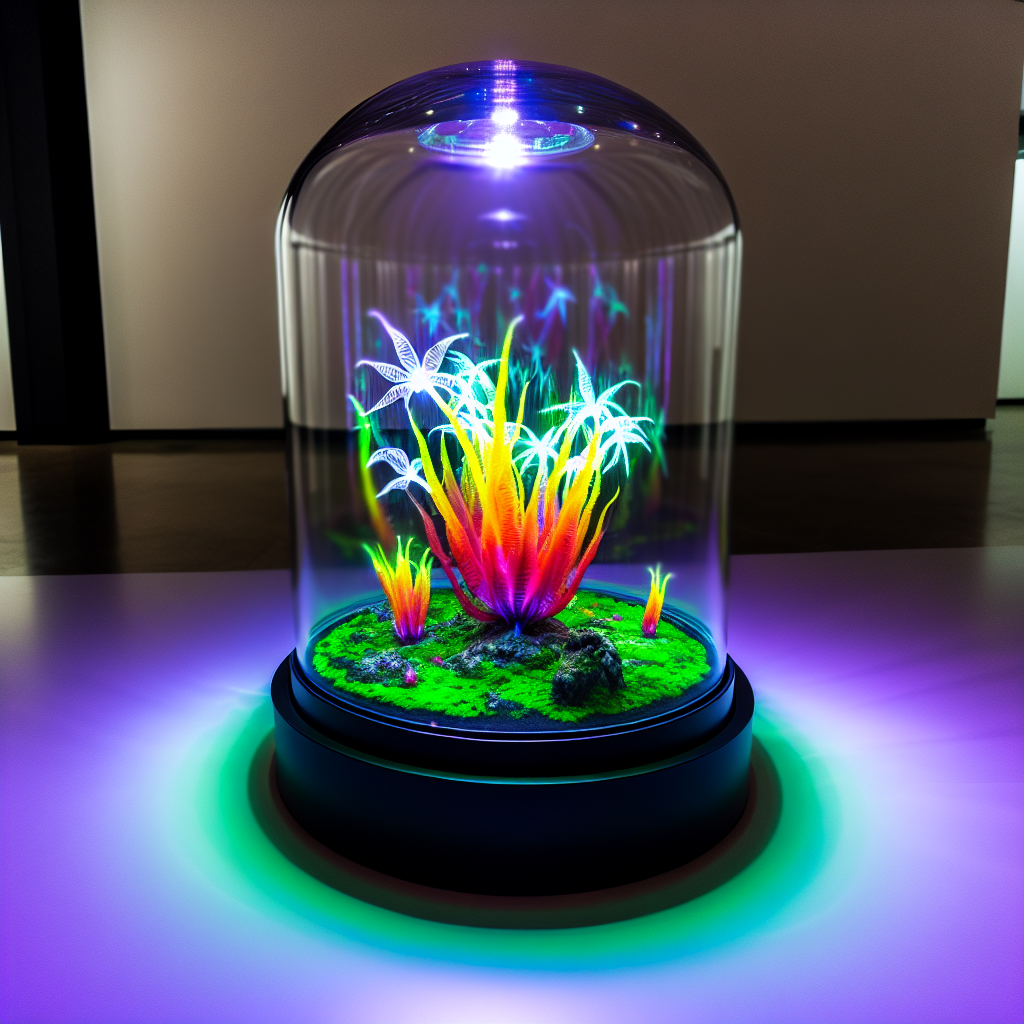
The Cosmic Flora is a remarkable bioluminescent plant specimen recovered from Exoplanet K-478, a distant world located in the habitable zone of a binary star system. This extraordinary organism represents one of the few confirmed examples of extraterrestrial life preserved in a state suitable for scientific study.
Unlike any terrestrial plant, the Cosmic Flora generates its own light through a complex biochemical process that remains partially understood. The specimen emits a soft, pulsating glow that shifts through the visible spectrum in patterns that appear to respond to environmental stimuli, suggesting a form of primitive awareness or communication.
Origin Story
The Cosmic Flora was discovered during the Kepler Extended Mission of 2023, when an unmanned probe landed on Exoplanet K-478 to collect soil samples. The probe's sensors detected unusual electromagnetic signatures emanating from a crystalline forest, leading to the discovery of an entire ecosystem of bioluminescent organisms.
This particular specimen was found growing at the edge of what appeared to be a vast underground fungal network that connected thousands of similar plants across the planet's surface. Analysis suggests this network may function as a planetary-scale communication system.
The careful extraction and transport of the living specimen required the development of specialized containment technology that could maintain the exotic atmospheric conditions of its home world during the journey to Earth.
Scientific Analysis
Biological Structure: The Cosmic Flora possesses a unique cellular structure that combines elements of both plant and animal biology. Its cells contain specialized organelles capable of producing light through a process similar to bioluminescence in deep-sea creatures, but far more efficient and versatile.
Energy Production: Unlike Earth plants, the Cosmic Flora does not rely solely on photosynthesis. It appears to absorb energy from multiple sources, including ambient radiation, thermal gradients, and possibly even quantum fluctuations in the local space-time fabric.
Communication Patterns: Dr. Helena Vasquez's xenobotany team has documented over 2,000 distinct light patterns emitted by the specimen, suggesting a complex form of non-verbal communication. Some patterns appear to repeat in response to specific stimuli, hinting at a form of memory or learning.
Regenerative Properties: Small samples taken from the specimen have demonstrated remarkable regenerative capabilities, with tissue samples regrowing complete miniature versions of the plant under laboratory conditions.
Discovery Information
| Discovery Date | March 12, 2023 |
|---|---|
| Location | Exoplanet K-478, Crystalline Forest Region, Sector 7 |
| Discovery Team | Kepler Extended Mission Probe K-47, Dr. Helena Vasquez (Remote Operations) |
| Extraction Duration | 4 months (March - July 2023) |
| Transportation | Bio-containment vessel aboard research drone Persephone |
| Museum Acquisition | September 2023 |
Cultural Significance
The Cosmic Flora represents humanity's first confirmed recovery of a living extraterrestrial organism. Its existence has profound implications for our understanding of life's prevalence in the universe and the diverse forms it may take under different planetary conditions.
The specimen has inspired artists, philosophers, and scientists alike, becoming a symbol of the beauty and mystery that await us in the cosmos. Its gentle, ever-changing glow has been described by visitors as "watching the heartbeat of an alien world."
Ethicists continue to debate the implications of keeping such a specimen in captivity, with some arguing for its eventual return to its home world as our technology advances.
Technical Specifications
| Dimensions | 38cm (H) x 25cm (W) x 25cm (D) |
|---|---|
| Weight | 2.3 kg |
| Age | 1.2 million years (estimated species age) |
| Material | Organic silicon-carbon hybrid cellular structure |
| Temperature | Maintained at -12°C (native environment simulation) |
| Luminescence | Variable 0.5-3 lumens, full spectrum emission |
| Atmosphere | Nitrogen-Argon mix with trace noble gases |
| Conservation Status | Active - Living specimen with specialized care |
| Display Location | Hall C, Gardens of Distant Worlds Exhibition |
| Security Level | Maximum - Biohazard and environmental controls |
Related Artifacts